Introduction
The goal of this documentation is to provide documentation for partners of the ecosystem around Mobilidata, who are looking for a technical deep dive.
For a general introduction it is better to check www.mobilidata.be/en or read the whitepaper.
Mobilidata
The architecture of the Mobilidata platform is at the service of fulfilling the needs and wishes of the Flemish government to improve traffic safety, efficiency and sustainability on its roads by realizing of a data infrastructure and innovate use cases that make use of that data.
To achieve this goal, the possibility to exchange data between different partners, suppliers and road authorities in a standardized manner is essential.
In this documentation, the design and handling of the information objects and -flows is put in a framework, which can be used by current or potential partners to build and interact within the Mobilidata environment.
To simplify deployment, reduce cost and increase the degree of acceptance, the use of existing technology is used as much as possible. International programs like C-Roads (EU), Talking Traffic (NL), Nordic Way (FI, NO, SE, DK) and the Data Task Force (EU) already paved the road for communication standards, message formats and centralized interchange mechanisms. This Mobilidata Framework will use and/or extend these standards for optimal use in Flanders, and possible extensions in the initiating programs.
Vision
The architecture of Mobilidata is in principle developed to fulfill the requirements of the Flemish government to improve road safety and optimize the usage of infrastructure. This is different from services like MAAS where there is a goal for optimizing the demand of single users. To achieve this generic character of the Mobilidata system, it has to serve as much information providers and receivers as possible. Therewith creating an environment of interest for as many as possible end-users.
Part of the above-mentioned goal, as addition to the generic C-Roads standard, is the emphasis on active road users (pedestrians, cyclists), a user group with specific demand regarding road safety.
For the start of the development, several use-cases are defined, for which the architecture is designed. But always bearing in mind that these use case can be altered or extended. In practice, all information receivers (service-providers) must be able to pick information for the specific use cases with content for their specific requirements. In the future, this will steer the character of the content. Is there no, or hardly, interest in a specific form of information, the flow of that information can be stopped. This is part of the dynamics in the design.
The environment is flexible enough to change with the alterations in real world and different demands, without losing the compatibility with international (C-Roads) systems and cross-border information exchange.
Adding value
Within the Mobilidata environment, there are 29 operational use cases defined for direct use or optimal support in combination with possible third-party data. The architecture is in line with other European mobility deployments, hence using all the existing standards and add-ons to enhance compatibility and create possibilities for improving the data quality based on road user feedback and other comparisons/analytics. In this way, the Mobilidata environment is capable to add effective value in the whole mobility ecosystem.
International standardization
In generic, the Mobilidata environment uses the basic standards of international smart mobility initiatives, but additionally add extensions to them where there is a necessity to enhance or update the value of applied services. The standards are derived from the following initiatives:
-
C-Roads
The C-ROADS Platform is a joint initiative of European Member States and road operators for testing and implementing C-ITS services considering cross-border harmonization and interoperability. -
Talking Traffic
The "partnership talking traffic" is a collaboration in The Netherlands between the Dutch Ministry of Infrastructure and Water Management, 60 regional and local authorities and national and international private companies. Together they work on the large-scale deployment of long-range C-ITS use cases in The Netherlands, including several C-ITS use cases related to traffic lights.
Use cases
There are 29 functional and 2 monitoring use cases defined as part of Mobilidata requirements in which the architecture must be compliant in supporting the information flow and excellent performing technology. Each use case is adding value to the end-user by the specific form of information it will provide, where not all use cases have to be combined.
These use cases are depicted in the below diagram. It divides this set of use cases in the following use case categories:
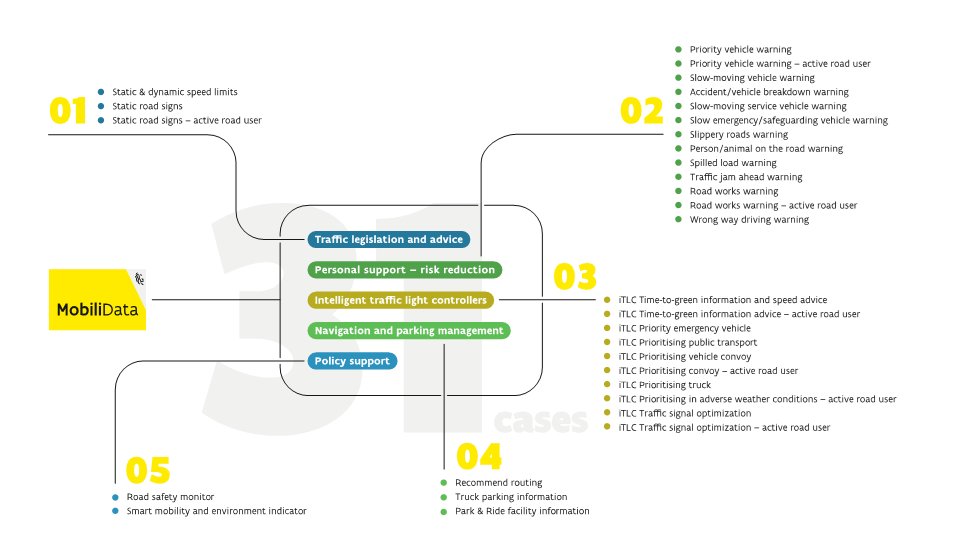
- Traffic legislation and advice
Providing static road information, like road signs or other roadside information for in-car notification. - Personalized road hazard warnings
These use cases are meant to provide the user information in better understanding actual traffic or infrastructure conditions in order to improve safety and traffic flow. Note, that not only drivers of vehicles like cars or trucks are mentioned but also bikers and pedestrians. - Intelligent Traffic Light Controllers
Increasing the efficiency of traffic lights is one of main goals of Mobilidata. To achieve this, the architecture and experience, gained in the Netherlands with Talking Traffic will be adjusted to the Flanders context. - Park and routing information
Providing of deviation of preferred routes, as well as information about existence of available parking space for specific vehicles. - Policy support applications
These applications target policy makers instead of road users as end user. They apply different forms of data analytics to datasets that were produced for the realization of the first four forms of use cases, to create new insights relevant for policy makers.
The use cases in relation to intelligent traffic light controllers all center around making traffic lights more intelligent, by supporting the following situations:
- Improve the flow of emergency vehicles at a traffic light:
Provide absolute priority (both green light and empty passage) to emergency vehicles that are legally allowed to go through a red light. - Supporting preference requests:
Provide conditional priority to road users. Based on type of vehicle (e.g. public transport, exceptional goods transport) or grouping of same type of road users. - Inform road users about the current and upcoming traffic light status, e.g. inform road users on e.g. time to "green light".
- Improve traffic control: manage traffic more efficiently, by providing it with real-time location data regarding the different road users around the intersection.
Information streams
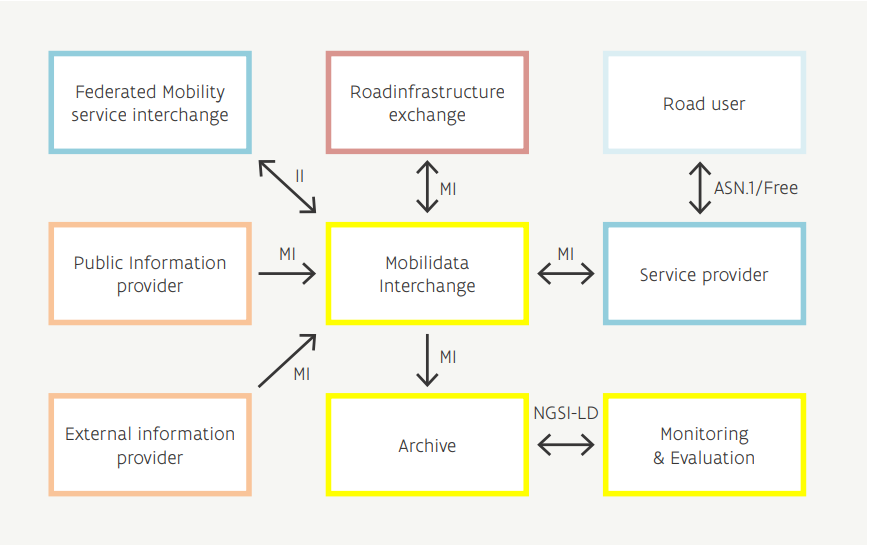
The information streams in the Mobilidata environment are based on, but not entirely the same as, the standards/protocols used by C-Roads, Talking Traffic, and others. Where it is essential or possible in providing the value needed, the original protocols (as managed/handled by the Mobilidata interchange) are extended with specific arguments. These additional arguments are proposed to become part of the standard itself.
The most important part in the information chain is the Mobilidata Interchange, via which public information providers, External information providers and road infrastructure (e.g. intelligent traffic lights) can interact with the service providers for end-users. The interchange (following C-Roads) is working with two interfaces:
- MI interface. This is an extended, but compatible, version of the C-Roads "Basic Interface" (BI), which is in essence a metadata envelope around standard ETSI or DatexII messages being exchanged using the AMQP protocol. This is the interface, used by Service providers.
- II interface. This "Improved Interface" is for communicating with other mobility environments about offered capabilities, allowing actors in the information chain to automatically adjust to the capabilities of an Interchange which they interact with.
For monitoring and analysis purposes, data is stored (taking GDPR in mind) in a historical archive from which the data is retrieved in NGSI-LD interface format. This will at any time be changed to Parquet format, the exact description of this format will follow.
Generic traffic information for public information provider function is derived from several data sources, administered by (local-)governments. The information will be converted to be compatible with a standard transmission method as described in previous paragraphs. Examples of public data sources are: GIPOD (database with road works data), static information about truck parking, calamity routes, road register, dynamic lane signals (RSS), dynamic zone 30.
Road users are serviced by (a) service provider(s) for Mobilidata communications. The service provider communicates with the interchange and is responsible for subscriptions, connection security and other user related handling. Priority requests from road users are send via the service provider to the RoadInfrastructureExchange and the relevant iTLC (iVRI).